Posts

Let's make math easy for everyone!

Image
Hello fellow teachers (candidates), Today I'd like to delve into the topic of differentiation when it comes to math. We know that as teachers we really need to delve into this notion that we need to accommodate for all learners. Teachers run into this dilemma of how do we accommodate for all our students and make sure that everyone is thriving in some way. How can we as teachers make sure that our strong students are challenged enough while our struggling students don't fall further behind? Good question! This is where differentiation becomes key. We as teachers need to focus on the fact that not all students learn the same or can keep up with each other but we need to offer incentives to keep going for those who struggle and challenges for those who need further enrichment. From the article I read in my class Differentiation Math Instruction  I was able to narrow down 3 important rules when it comes to differentiating:  Focus the instruction needed on key concepts. Lea...

Its all in our message and math madness!

Image
Hello everyone, Welcome back to my blog on math. Today were here to talk about a couple different things. I'd first like to keep going with the flow of how my last blog ended. I was talking about the growth mindset and how we need to help our students to achieve this. Well lets continue with this conversation and delve into the idea that messages convey some pretty deep meanings to our students. As teachers we wonder why our students change their mindset as soon as we say these three words "you are smart." This is because by telling our students they are smart at something makes them not want to try as hard anymore. We can see that students start to say I will take the easier problem because they know they can do it easily and don't want to risk letting us down by doing something harder. This week we looked into this notion and noticed that the students who we said you did awesome trying vs you are so smart tried harder problems when asked which problem they w...

Math IS for EVERYONE!!!!!!

Image
Hello my fellow teacher colleagues, Today I'd like to discuss with you something that we've been talking about in our math classes. We know either now or in the near future we will have that child in our classroom who just tells you they really suck at math. They will tell you there is no point trying I just can't. Or they will not try because they know they will fail and they would rather just not put that much effort in. We get to the point where all we can say is.... But really what if we started saying hey you are smart we just need to get you to try. Maybe we can try to change the questions to make them easier to understand. Maybe we can try to add more real life scenarios that our kids would say hey this is funny I can probably do this. Maybe we need brush up on our popular culture characters and stories to be able to add this in to our assignments so it makes kids get more interested in it. Examples:  If your kids are into pokemon here is a link  with di...

Let's Look at Math Games

Image
Hey Guys, Here we are the end of class and we are exploring different math games that we can integrate into our lessons. I got to delve into the world of Prodigy. Here is the link  to the website. I'm also attaching here a tutorial on how to set your account and use this in the classroom. Prodigy is a math game that incorporates gamification. Students will battle each other or just other computer opponents using math problems. This game is for grades 1-8 and can be interchangable between the grades, math strand, or curriculum expectation. Teachers have the ability to use the dashboard to designate what questions are used during a certain period. If they are dealing with fractions, the teacher can make sure the questions they have to answer is based on fractions. This makes it easier for a teacher to hit any specific & overall expectations for any grade and any strand needed to go over at that particular time in the semester. For example however I can look at grade 4 (jus...

Using Technology for learning and Assessing that math learning!

Image
Hey guys, So today we began our class looking at different ways to integrate technology into our tech classrooms. We discovered that there are now so many games or apps to go along with whatever lesson you want to teach. I presented today using the money by mathies app. This app can be downloaded for free and can be used for any grade. It is a virtual cash draw that can help to visual money without having actual money in students hands. As they get into older grades they need to learn how to add, subtract, multiply and divide money into higher and higher denominations. You can create your lesson using this such as I created a simple word sheet that asked you to represent certain amounts of money based on loonies, toonies, nickles, dimes, quarters, and bills. I also asked a general question to gauge where students are such as if you have two bills and 5 coins what would you have and how did you come to this.  Next Ryan had a game called Math Duel. This was a g...

using data to predict probability

Image
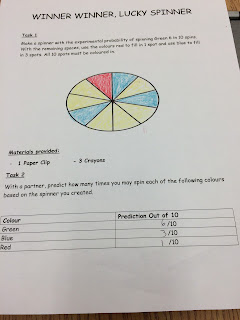
Hey everyone, Doucette, K. Nov. 17th 2017. "Winner Winner, Lucky Spinner." Retrieved from own personal library Here we do again this time let's figure out how to display and how to figure out probability. Two exciting topics we may use in our everyday lives. In our groups today Tyler did a wonderful display of probability using a spinner. He developed a game that was appropriate for grade 5 students. He is using an unfair spinner to figure out what the probability would be of landing on each colour. He picked 3 colours with different variables of all. This made it an unfair spinner. To make it fair when first learning you could make the spinner have all equal colours on the spinner. The exercise was then to see after 10 spins how many variables you land on to see if your predictions were right. In our case they were not right as I landed more on green than any other colour. To add in another part of the curriculum students  could make the spinners into an art proj...

Let's get measuring

Image
hello everyone, Doucette, K. Nov. 10th 2017. "Perimeter and Area." Retrieved from own personal library Today we're exploring the wonderful world of measurement. Our peers today included 3 different activities that involved measurement. Pictured to the left we had an activity that started with the basics of area and perimeter. Something we learn in grade 4. There was a goal of figure out how many rectangles you could make (using the blocks) that made an area of 36. Younus started a quick lesson with how to find area (length times width) and perimeter (length plus width plus length plus width). With this in mind we could find 10 possibilities which was actually translated to 5 possibilities with 5 others being an inverse of each other. After this we could find the perimeter which was easily seen with the blocks. This can make it easier for some students to visually see. However we need to take into consideration when counting the sides we need to think of the perimete...